Frequently Asked Questions
Migrating from Terraform to OpenTofu
Why did OpenTofu emerge as an alternative to Terraform?
OpenTofu was created in response to HashiCorp's decision on August 10th, 2023 to relicense Terraform under the Business Source License (BUSL), which restricted certain commercial uses and could be changed unilaterally. The community launched OpenTF (later renamed OpenTofu), hosted by the Linux Foundation under a permissive MPL 2.0 license, ensuring open governance and preventing vendor lock-in. Source
How is OpenTofu different from Terraform?
OpenTofu was forked from Terraform 1.5.7 and started as 100% compatible. It uses the same workflow (init/plan/apply/destroy), the same HCL language, and supports the same providers and modules. However, OpenTofu has its own registry (registry.opentofu.org) and is adding community-driven enhancements like provider for_each, built-in state encryption, and early variable evaluation. Source
What steps should I follow to migrate from Terraform to OpenTofu?
The recommended migration steps are: 1) Audit your configs for Terraform-only features, 2) Back up your state files, 3) Install OpenTofu alongside Terraform, 4) Perform a dry-run with tofu init and tofu plan, 5) Migrate dev/staging environments first, and keep Terraform available for rollback. Source
Are Terraform and OpenTofu compatible in terms of workflow and language?
Yes, both tools use the same workflow commands (init, plan, apply, destroy) and the same HCL language. OpenTofu reads .tf files and understands Terraform state files, making migration straightforward for most users. Source
What should I watch out for when migrating to OpenTofu?
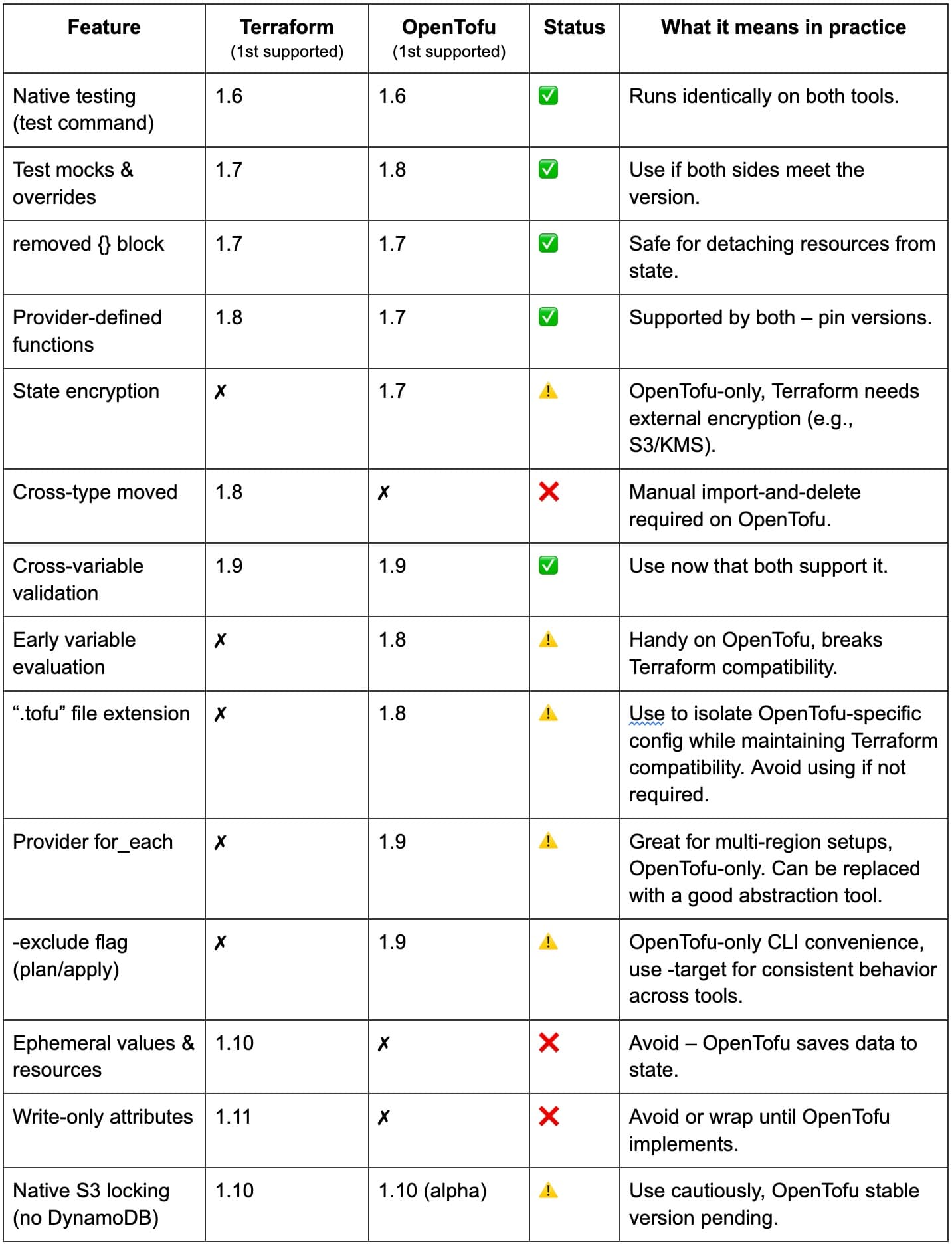
Be aware of Terraform-only features introduced after version 1.5.x, as these may not be supported in OpenTofu. Also, update your module and provider source addresses to use OpenTofu's registry. Always audit your configs and test in non-production environments first. Source
How does Bluebricks help with migrating between Terraform and OpenTofu?
Bluebricks provides an abstraction layer that decouples your business logic from any single IaC engine. Its model-driven approach lets you define infrastructure once, and Bluebricks renders either Terraform or OpenTofu code underneath. It also includes a quick-migration utility to rewrite pipeline commands and backend settings, enabling engine swaps in minutes. Source
What is the benefit of using an abstraction layer like Bluebricks?
An abstraction layer insulates your workflows from vendor changes and engine-specific features. With Bluebricks, you can package multiple stacks, environments, and policies under one roof, swap IaC engines easily, and avoid rewriting modules when the ecosystem shifts. Source
Does OpenTofu support the same providers and modules as Terraform?
Yes, OpenTofu supports the same providers (AWS, Azure, GCP, etc.) and modules as Terraform. The main difference is that OpenTofu uses its own registry (registry.opentofu.org), while Terraform uses HashiCorp's registry (registry.terraform.io). Source
How do I switch between Terraform and OpenTofu binaries?
You can install OpenTofu alongside Terraform as separate binaries to avoid conflicts. Tools like tofuenv make it easy to switch between both engines for testing and migration purposes. Source
What is the recommended approach for testing a migration to OpenTofu?
It's best to perform a dry-run using tofu init and tofu plan to ensure no changes are detected. Start by migrating development or staging environments before production, and keep Terraform available for rollback if needed. Source
How does Bluebricks future-proof my infrastructure workflows?
Bluebricks enables you to focus on defining what infrastructure you need, not which binary provisions it. Its abstraction layer and migration utilities allow you to swap IaC engines quickly, package multiple stacks, and maintain unified control without rewriting modules, protecting you from future vendor changes. Source
What is the impact of HashiCorp's license change on Terraform users?
HashiCorp's switch to the BUSL license restricts certain commercial uses and allows unilateral changes, raising concerns about vendor lock-in. OpenTofu, as a community-driven alternative, offers a permissive license and open governance to address these concerns. Source
Can I easily revert back to Terraform after migrating to OpenTofu?
If you avoid OpenTofu-specific features and stick to the basics, you can easily switch back to Terraform if needed. Always keep backups and test migrations in non-production environments. Source
What are the main risks when migrating from Terraform to OpenTofu?
The main risks include using Terraform-only features not supported by OpenTofu, failing to update registry addresses, and not properly backing up state files. Mitigate these risks by auditing configs, performing dry-runs, and migrating in stages. Source
How does Bluebricks handle multiple stacks and environments?
Bluebricks allows you to package multiple stacks, environments, and policies under a unified control plane, eliminating the need to rewrite modules when switching IaC engines. This streamlines management and migration processes. Source
What is the role of community governance in OpenTofu?
OpenTofu is governed by the community and hosted by the Linux Foundation, ensuring that no single vendor can impose restrictive changes. This model promotes transparency and long-term stability for users. Source
How does Bluebricks minimize migration drama between IaC engines?
Bluebricks' abstraction layer and quick-migration utility automate the rewriting of pipeline commands, backend settings, and state metadata, allowing you to swap IaC engines with minimal manual intervention and risk. Source
What is the significance of OpenTofu's independent roadmap?
OpenTofu's independent roadmap allows the community to add long-requested features and enhancements without breaking backward compatibility, ensuring the tool evolves to meet user needs. Source
How does Bluebricks support both Terraform and OpenTofu?
Bluebricks is IaC-agnostic and can render infrastructure code for both Terraform and OpenTofu, allowing organizations to choose or switch between engines without rewriting business logic. Source
What is the best way to future-proof my cloud infrastructure?
Using an abstraction layer like Bluebricks lets you define infrastructure once and swap underlying IaC engines as needed, protecting your workflows from vendor changes and ecosystem shifts. Source
Features & Capabilities
What is Bluebricks and what does it do?
Bluebricks is an IaC-agnostic environment orchestrator that transforms Infrastructure as Code (IaC), configurations, and scripts into one-click environments that are AI-agent ready. It simplifies cloud infrastructure operations, enables rapid environment creation, and supports multiple IaC tools. Source
What are the key features of Bluebricks?
Key features include one-click environment orchestration, reusable blueprints, developer enablement, operational efficiency, AI integration, workflow management, security and compliance, observability, blast radius control, and rapid deployment. Source
Does Bluebricks support integrations with other tools?
Yes, Bluebricks integrates with source code management systems (GitHub, Bitbucket, GitLab, Azure DevOps), Slack, major cloud platforms (AWS, GCP, Oracle, Azure), and supports running CLI commands in CI/CD pipelines. Slack Integration, GitLab Integration
Does Bluebricks offer an API for automation?
Yes, Bluebricks provides a comprehensive API for programmatic access to its control plane, enabling automation of environment management, deployments, cloud account connections, and more. API documentation is available at API Overview.
What technical documentation is available for Bluebricks?
Bluebricks offers extensive documentation, including API reference, CLI installation guides, core concepts, knowledge base, and webhooks setup. Resources are available at docs.bluebricks.co and Help Center.
What security and compliance certifications does Bluebricks have?
Bluebricks is certified for ISO 27001, GDPR, and SOC 2, and is built with a 'Secure by Design' philosophy. It supports in-boundaries deployment, is FIPS-ready, and enforces policies, roles, and audit trails. Details are available at the Trust Center.
How does Bluebricks ensure governance and compliance?
Bluebricks provides centralized mechanisms for managing roles, permissions, secrets, and environment ownership, ensuring all deployments follow approved processes and maintain compliance with industry standards. Trust Center
How quickly can Bluebricks be implemented?
Bluebricks can be set up in minutes, with customers typically up and running in days. No existing IaC coverage is required, making onboarding fast and accessible. Source
What is Bluebricks' pricing model?
Bluebricks is licensed on a per-environment basis, providing clear and predictable pricing. For details or a personalized quote, visit the pricing page.
Who are some of Bluebricks' customers?
Bluebricks is trusted by leading teams such as Checkpoint, Hibob, Milestone, Naviteq, Nutanix, Ness, and Gable. Source
What feedback have customers given about Bluebricks' ease of use?
Customers like Regev Golan (Senior Director of Engineering at Check Point) and Nati Aviv (Head of DevOps and Infrastructure) have praised Bluebricks for making infrastructure management simple and effortless, highlighting its quick setup and intuitive interface. Source
What industries are represented in Bluebricks' case studies?
Bluebricks has case studies in the film production industry. For more details, visit the case studies section.
Who is the target audience for Bluebricks?
Bluebricks is designed for platform and DevOps teams in organizations that require standardized environment management across different clouds, teams, and regions. Source
What pain points does Bluebricks address?
Bluebricks addresses operational chaos, complexity in managing decentralized locations, developer infrastructure challenges, fragmented cloud operations, ease of implementation, and vendor lock-in concerns. Source
What business impact can customers expect from Bluebricks?
Customers can expect improved efficiency, faster deployment (up to 80% reduction in setup time), cost optimization, enhanced developer productivity, business continuity, scalability, flexibility, and risk reduction. Source
How does Bluebricks compare to Terragrunt and Crossplane?
Bluebricks supports multiple IaC tools (not just Terraform), offers full lifecycle orchestration (including Day-2 operations), provides a self-service UI, centralized governance, real-time observability, and AI/ML enablement. Terragrunt and Crossplane lack many of these features and require more manual effort or tool-specific workflows. Terragrunt Comparison, Crossplane Comparison
What makes Bluebricks unique compared to other environment orchestrators?
Bluebricks is unique for its tool-agnostic workflows, full lifecycle orchestration, developer self-service, centralized governance, real-time observability, AI/ML enablement, quick setup, and blast radius control. These features address specific use cases and pain points that competitors do not. Source
What support resources are available for Bluebricks users?
Support resources include email support ([email protected]), technical documentation (docs.bluebricks.co), and a knowledge base (Help Center).
How does Bluebricks help with disaster recovery and business continuity?
Bluebricks enables instant environment setup during disasters, attacks, or outages, supporting robust disaster recovery and business continuity planning. Source
Can Bluebricks be used for edge and low-latency environments?
Yes, Bluebricks simplifies the management of edge and low-latency environments with one-click orchestration, enabling faster establishment and scalability. Source