> For the complete documentation index, see [llms.txt](https://bluebricks.co/docs/llms.txt). Markdown versions of documentation pages are available by appending `.md` to page URLs; this page is available as [Markdown](https://bluebricks.co/docs/orchestration/bluebricks-git-repository-guide/managing-configuration-on-git.md).
# Managing Configuration on Git
Use declarative environment files and PR-based workflows to manage infrastructure provisioning through Git with Bricks Action
By integrating with Bricks Action, teams can "shift-left" infrastructure provisioning and maintain PR-based workflows, leveraging developer-friendly and GitOps-compatible declarative files.
## Recommended Workflow Described
Below is a suggested opinionated workflow that can be modified according to the team's needs.
1. Developers leverage side branches to provision their infrastructure. Each commit triggers a environment to a developer-owned environment
2. Once the changes are ready, the engineer opens a Pull Request (PR) to promote the change for review and obtain approval before merging and deploying to shared environments.
3. Once the Pull Request (PR) is approved, the engineer merges its code and waits for the next release day.
4. On the release day, the DevOps team should trigger a workflow that detects the recent changes and creates a batch environment.
### Batch Environments
Bluebricks recommends aligning infrastructure modifications with the primary SDLC.
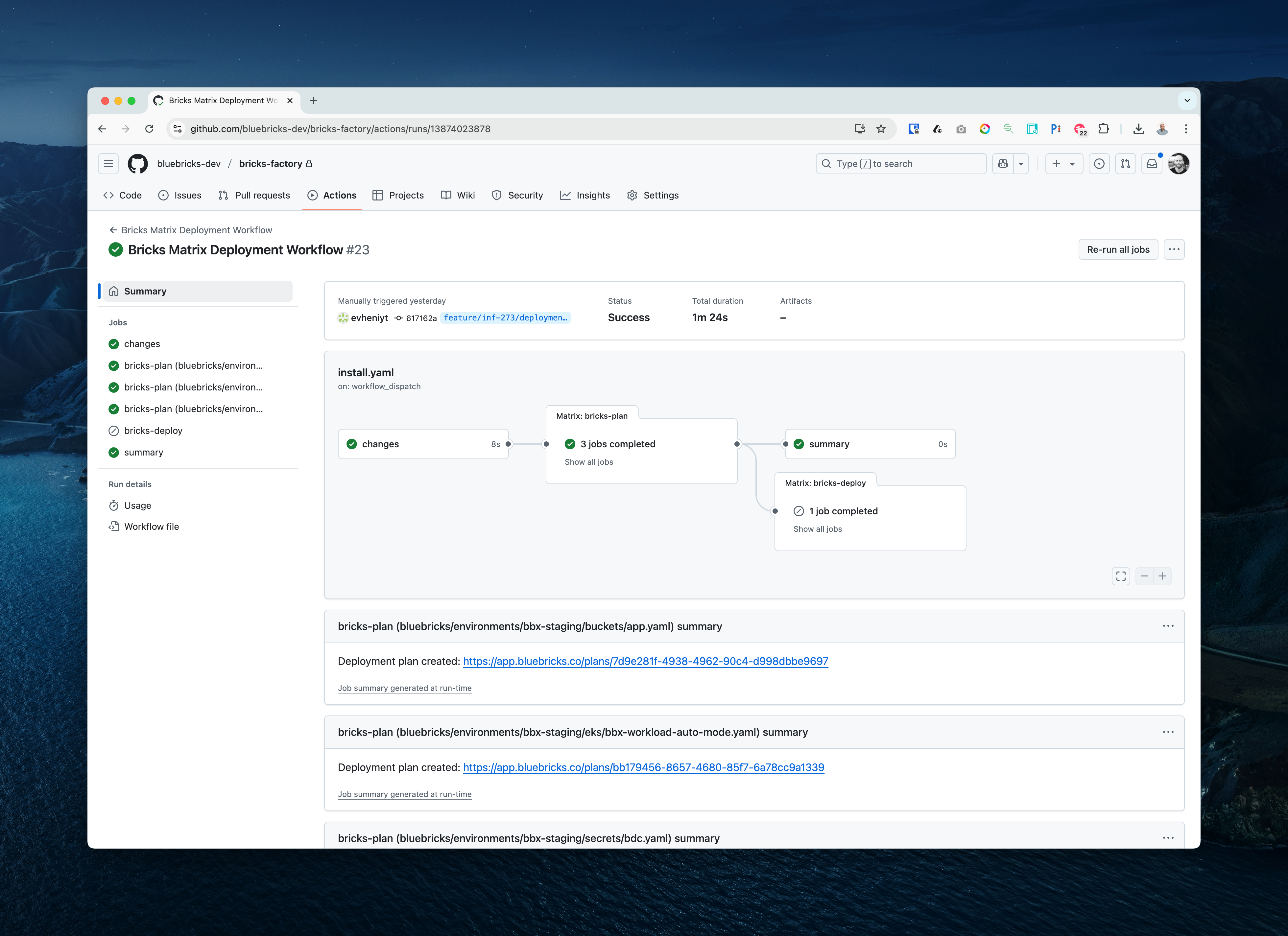
On release day, the Delivery team manually triggers or automates a workflow using a ticketing system; the GitHub Action Workflow should collect the recent changes and trigger installation for each.
This approach ensures:
1. Synchronized application and infrastructure releases.
2. Controlled, predictable, and repeatable environments.
3. Automation-driven efficiency with minimal manual intervention.
### Github Action Workflow Example
```
name: Bricks Matrix Environment Workflow
on:
pull_request:
branches: [master]
paths:
- 'bluebricks/collections/**'
push:
branches:
- master
- feature/inf-273/environments
paths:
- 'bluebricks/collections/**'
workflow_dispatch:
inputs:
plan_only:
description: 'Generate plan only without deploying'
required: true
default: true
type: boolean
jobs:
# Detect changes in environments folder and prepare matrix
changes:
runs-on: ubuntu-latest
outputs:
matrix: ${{ steps.set-matrix.outputs.matrix }}
any_changes: ${{ steps.set-matrix.outputs.any_changes }}
steps:
- name: Checkout code
uses: actions/checkout@v4
with:
fetch-depth: 0 # Fetch all history for detecting changes
- name: Get changed files
id: changed-files
# For PRs use git diff, for manual runs find all YAML files
run: |
if [[ "${{ github.event_name }}" == "pull_request" ]]; then
# Get changed files in PR
CHANGED_FILES=$(git diff --name-only ${{ github.event.pull_request.base.sha }} ${{ github.sha }} -- bluebricks/environments/ | grep -v values.yaml | grep -E '\.ya?ml$' || echo "")
else
# For workflow_dispatch, consider all YAML files
CHANGED_FILES=$(find bluebricks/environments -type f \( -name "*.yaml" -o -name "*.yml" \) ! -name "values.yaml" | sort)
fi
echo "Files to process:"
echo "$CHANGED_FILES"
{
echo "CHANGED_FILES<> "$GITHUB_ENV"
- name: Set matrix
id: set-matrix
run: |
# Convert changed files to JSON array format
if [[ -z "$CHANGED_FILES" ]]; then
echo "No environment files changed"
echo "matrix=[]" >> $GITHUB_OUTPUT
echo "any_changes=false" >> $GITHUB_OUTPUT
else
# Convert space separated file list to JSON array
FILES_JSON=$(echo "$CHANGED_FILES" | jq -R -s -c 'split("\n") | map(select(length > 0))')
echo "matrix=${FILES_JSON}" >> $GITHUB_OUTPUT
echo "any_changes=true" >> $GITHUB_OUTPUT
fi
# Create environment plans for all changed files
bricks-plan:
needs: changes
if: needs.changes.outputs.any_changes == 'true'
runs-on: ubuntu-latest
strategy:
matrix:
file: ${{ fromJson(needs.changes.outputs.matrix) }}
# Allow other environments to continue even if one fails
fail-fast: false
# Limit parallel executions to avoid rate limiting
max-parallel: 5
steps:
- name: Checkout code
uses: actions/checkout@v4
- name: Extract environment name
id: extract-name
run: |
# Extract environment name from file path for use in job display
FILENAME=$(basename "${{ matrix.file }}")
ENVIRONMENT_NAME=${FILENAME%.*} # Remove extension
echo "name=$ENVIRONMENT_NAME" >> $GITHUB_OUTPUT
- name: Create Bricks environment plan (${{ steps.extract-name.outputs.name }})
uses: bluebricks-co/bricks-action@support-for-install-flow
with:
command: install
file: ${{ matrix.file }}
# env: ${{ github.event.inputs.environment || 'staging' }}
plan-only: ${{ github.event.inputs.plan_only || 'true' }}
api-key: ${{ secrets.BRICKS_API_KEY }}
# Deploy if workflow_dispatch and plan_only is false
bricks-deploy:
needs: [changes, bricks-plan]
if: |
needs.changes.outputs.any_changes == 'true' &&
github.event_name == 'workflow_dispatch' &&
github.event.inputs.plan_only == 'false'
runs-on: ubuntu-latest
strategy:
matrix:
file: ${{ fromJson(needs.changes.outputs.matrix) }}
fail-fast: false
max-parallel: 3
steps:
- name: Checkout code
uses: actions/checkout@v4
- name: Extract environment name
id: extract-name
run: |
FILENAME=$(basename "${{ matrix.file }}")
ENVIRONMENT_NAME=${FILENAME%.*}
echo "name=$ENVIRONMENT_NAME" >> $GITHUB_OUTPUT
- name: Execute Bricks environment (${{ steps.extract-name.outputs.name }})
uses: bluebricks-co/bricks-action@support-for-install-flow
with:
command: install
file: ${{ matrix.file }}
api-key: ${{ secrets.BRICKS_API_KEY }}
summary:
needs: [changes, bricks-plan]
if: always() && needs.changes.outputs.any_changes == 'true'
runs-on: ubuntu-latest
steps:
- name: Environment Summary
run: |
echo "### Environment Summary" >> $GITHUB_STEP_SUMMARY
echo "" >> $GITHUB_STEP_SUMMARY
echo "Processed Environment files:" >> $GITHUB_STEP_SUMMARY
# Use a more reliable approach that avoids complex JSON parsing
matrix='${{ needs.changes.outputs.matrix }}'
# Method 1: Simple approach that works even if JSON is malformed
echo "$matrix" | grep -o '"[^"]*"' | sed 's/"//g' | while read file; do
echo "- $file" >> $GITHUB_STEP_SUMMARY
done
# Method 2 (Fallback): If nothing was listed above
if ! grep -q "^-" $GITHUB_STEP_SUMMARY; then
echo "- No files were processed or could not parse file list" >> $GITHUB_STEP_SUMMARY
fi
```